
“Making History Together”
An HTI Open Plaza virtual tour of the Smithsonian’s forthcoming National Museum of the American Latino
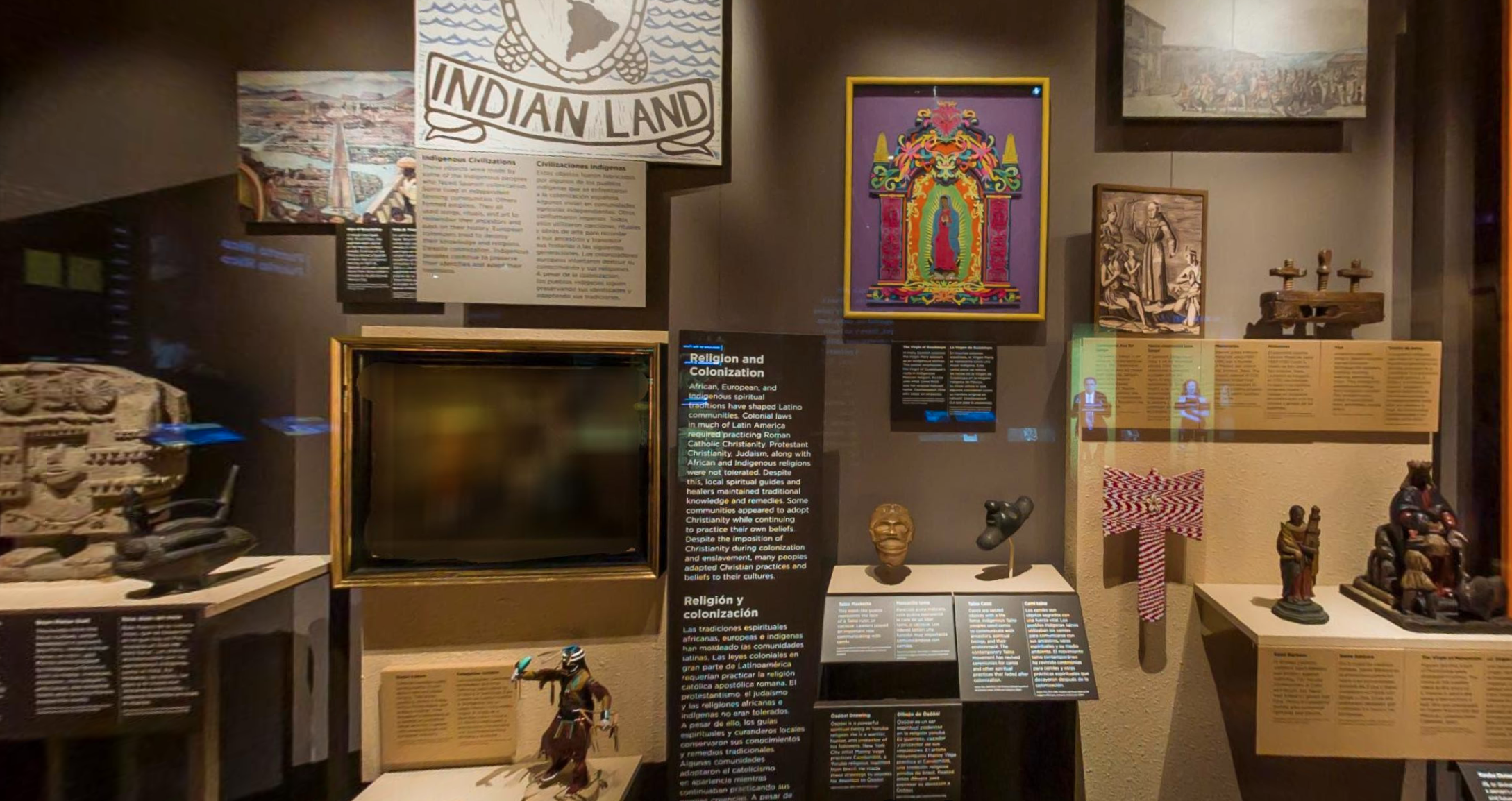
Virtual-tour image capture of “Case 1- Colonial Legacies,” part of the Molina Family Latino Gallery exhibit ¡Presente! A Latino History of the United States, National Museum of the American Latino, November 2023.
In honor of National Hispanic Heritage Month 2024, HTI Open Plaza highlights artifacts and resources from the National Museum of the American Latino and other areas of the Smithsonian Museum of American History that engage faith, religion, and spirituality.
“Religion continues to be an important part of daily life for many Latinos and Latinas in the United States, even as contemporary trends are emerging. Fewer Latinos and Latinas are identifying as Catholic and evangelical Christianity is on the rise. Still, other Latinos consider themselves to have no religious affiliation. There are also many non-Christian faiths practiced in Latino communities. About two percent of U.S. Latinos practice Judaism, Buddhism, Santería, and other non-Christian belief systems.”
–”Latino Identity: Connecting to the Present,” ¡Presente! A Latino History of the United States, NMAL
Background
The Smithsonian Institution has been in the process of building the National Museum of the American Latino (NMAL) since the mid-1990s. Its mission to advance “the representation, understanding and appreciation of Latino history and culture in the United States” has been met with multiple roadblocks for nearly three decades (see timeline below). Since 2022, the NMAL has been housed at the National Museum of American History as the Molina Family Latino Gallery, the Smithsonian’s first gallery dedicated to the Latino experience. The stand-alone NMAL building is expected to open sometime between 2032 and 2034.
Timeline

Current Status
The Molina Family Latino Gallery launched a preview of the NMAL through its inaugural exhibition ¡Presente! A Latino History of the United States in June of 2022. ¡Presente! “uncovers hidden and forgotten stories, connects visitors to Latino culture, and lays the foundation for understanding how Latinas and Latinos inform and shape U.S. history and culture.” The exhibit includes “ceremonial and religious objects connected to African, European, and Indigenous spiritual traditions that have had enduring effects on Latino communities.”
Soon after launch, the ¡Presente! exhibit—and the proposed museum—was roundly denounced by three conservative political commentators, as summarized by Olivia B. Waxman in a 2023 TIME article:
The Hill published an op-ed by [Alfonso Aguilar, President of the Latino Partnership for Conservative Principles]; Joshua Treviño, a director at the Texas Public Policy Foundation who previously worked in former President George W. Bush’s administration; and Mike Gonzalez, a fellow at the conservative think tank The Heritage Foundation who was a member of the 1776 Commission that Donald Trump appointed partly in reaction to the New York Times’ 1619 Project, which aimed to reframe the story of America’s founding over the first Africans landing in Virginia. If what was on display at the Molina gallery was any indication of what the National Museum of the American Latino would be like, it will be an “unabashedly Marxist portrayal of history, religion and economics,” the authors wrote. “Its only redeeming quality is that it makes clear why the forthcoming National Museum of the American Latino must not be funded.”
The criticism led to the holdup of the next exhibit, which was slated to launch in 2025. For the past two years, HTI alum Dr. Felipe Hinojosa and fellow historian Dr. Johanna Fernández “had been working to develop an exhibit about the history of Latino youth movements that would help serve as a preview for the new museum,” according to Waxman. Dr. Hinojosa is the author of Apostles of Change: Latino Radical Politics, Church Occupations, and the Fight to Save the Barrio (University of Texas Press, 2021). Dr. Fernández is the author of The Young Lords: A Radical History (UNC Press, 2020); in 2015, she directed and co-curated ¡Presente! The Young Lords in New York, an exhibition in three New York City museums that was cited by the New York Times as one of the year’s Top 10, Best In Art.
Waxman describes the two scholars’ plans for the NMAL exhibit and the ensuing controversy:
The show was supposed to be the largest federally funded Smithsonian exhibit on Latino civil rights history, and it drew input from the nation’s top Latino historians and veterans of the movement. It was set to feature student walkouts, efforts to integrate schools, and environmental and immigration activism…But after pushback from conservative Latinos in the private sector and the halls of Congress, that exhibit is on hold. A new one on salsa and Latin music is being developed in its place, the Smithsonian confirmed…The incident is part of a larger fight that will determine who gets to tell the history of Latinos in the museum dedicated to it. The fate of the museum itself may be at stake. On one side are liberal historians like Johanna Fernandez and Felipe Hinojosa…On the other are conservative Hispanic political activists and Cuban-American politicians like Florida Congressman Mario Diaz-Balart, who voted to defund the museum this summer…Conservative activists are adamant that Latinos should not be painted as victims of oppression, while liberal historians believe that the Latinos’ fight against injustice is a vital part of this history…“The tragedy and really the story here,” says Hinojosa…“is around who controls the future of Latino history.”
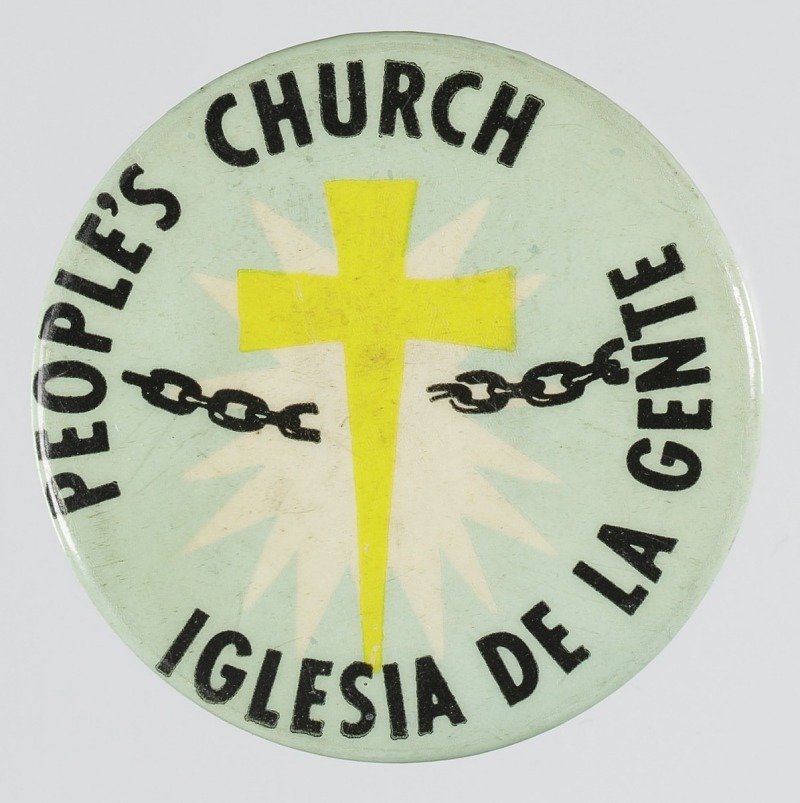
La Gente’s Museum
In a companion OP Talks podcast feature, Dr. Johanna Fernández and fellow historian Dr. Felipe Hinojosa discuss the controversy surrounding their proposed exhibit at the Smithsonian National Museum of the American Latino.
LISTEN
Funding
In 2023, the Smithsonian received a $10 million grant from Lilly Endowment Inc. to support “the development and implementation of strategies for highlighting the role of religion in Latino history and culture through the museum’s collections, exhibitions and public programming,” according to an NMAL press release.
“The study of faith and spirituality,” it maintains, “provides a framework for comprehending the culture, identity and interconnections of diverse Latino communities and their relationships with other faith communities.” The grant, said Lonnie Bunch, Secretary of the Smithsonian, “will help amplify Latino voices and contributions for generations to come while adding a new layer to the Smithsonian’s scholarly work in understanding the ways religion has shaped humanity.”

Photo: Morgan Fischer/Cronkite News. For more stories from Cronkite News, visit cronkitenews.azpbs.org.
VIRTUAL TOUR
-
The artifacts featured draw information from NMAL’s ¡PRESENTE! A Latino History of the United States exhibit, as well as Smithsonian Museum resources related to altars/ofrendas.
Smithsonian museum names are abbreviated as follows:
NMAL- National Museum of the American Latino
NMAH- National Museum of American History
NMAI- National Museum of the American Indian
SAAM- Smithsonian American Art Museum
¡PRESENTE! A Latino History of the United States
Ofrendas/Altars
-
Explore the ¡Presente! exhibition in the Molina Family Latino Gallery as it looked when it first opened to the public in June 2022 (some objects have since been rotated).
-
+Po’Pay
+Nicoya female figure-vessel
+La Virgen de Guadalupe
+La Virgen de Monserrate
+Taíno cemi
+El Santo Niño de Atocha
+La Divina Pastora (The Good Shepherdess)
+Danse des Californiens
+Santa Barbara
+Autorretrato
+Divination tray (ọpọ́n Ifá) -
+Teresa Ruelas’s Bible
+Digital illustration of Teresa Ruelas (born Guerra)
+Sánchez Family crucifix and photograph
+Margarita Lora’s dress
+Black Cuban, Black American: A Memoir by E. Grillo
+Viajando con Mis Raíces (Traveling with My Roots) by Samuel ‘Sami’ Miranda -
+Pablo Tac
+Ritual outfit
+Ceremonial axe for Ṣàngó -
+Padre Félix Varela USPS commemorative stamp
+Ọpọ́n Ifá divination tray
+Tree of Life
-
+The Meaning of the Altar
+ A Room of Her Own: Una Ofrenda for My Mother (Su propia habitación: Una ofrenda para mi madre) by Sandra Cisneros
+ Honoring Our Ancestors
-
+Preparatory sketch for a New Mexican retablo by Marie Romero Cash
+Homemade San Antonio altar by Kathy Vargas
+A New Mexico teacher’s altar made from scratch by Charles M. Carrillo
+An ode to a Mexican cinema icon (and later her mother) by Amalia Mesa-Bains
-
+ "Healing Uvalde" Mural Project
+ The San Antonio Immigrant Memorial
+ El Paso Walmart Massacre Mural
+ Resilience and Remembrance at El Paso, Texas
¡PRESENTE! A Latino History of the United States
The Molina Family Latino Gallery’s inaugural exhibition, ¡Presente! A Latino History of the United States is an introduction to critical concepts, moments, and biographies that shine a light on the historical and cultural legacy of U.S. Latinas and Latinos. The exhibit will be on view until December 1, 2024. Also, feel free to download the Smithsonian and USA TODAY 12-page guide or view the exhibit companion website.
360° Self-Guided Virtual Tour
Historical Legacies
-
The stoneware sculpture of Po’Pay (Revolt 1680/2180 Series) is by Indigenous artist Virgil Ortiz (Cochiti Pueblo, New Mexico), who works within a matrilineal tradition of renowned Pueblo potters.
***
From ”Watching Over the Past,” American Indian 23.2 (Summer 2022), NMAI:
“‘When the first invaders first arrived into the area, a bunch of the artwork was broken and destroyed, lost. The Indigenous people were accused of sorcery and witchcraft, making all these different types of artworks,’ said Ortiz. ‘The Catholic religion [was trying to] stamp out everybody and convert them into Catholicism. All the Indigenous people were enslaved, and all these different people started moving into the Pueblos.’
“After the Spanish governor of New Mexico ordered Pueblo holy men whipped or executed, a Pueblo leader named Po’pay led a successful revolt in 1680, which kept the Spanish out of the state for 12 years. ‘We fought back,’ said Ortiz. ‘That’s how the Pueblo Revolt took off. It pulled everybody together.’
“The Pueblo Revolt’s success was instrumental in keeping many Pueblo cultural teachings, languages and artforms alive. The Pueblo peoples started making pottery again, and Ortiz has dedicated his artistic career to perpetuating its revival.”
-
“In some Central American ceramic figurines, it is possible to identify the wearing of ear spools, necklaces, and headdresses of magnificent fabrication, as well as clothing and body painting. The representation of these accessories was a symbol of social and spiritual authority. —NMAL
This figurine of a Nicoya ruler was created in the Greater Nicoya region, which is now Costa Rica. It is “one of many amazing items from the little-known pre-Contact Central American cultures” (American Indian, Spring 2015, NMAI).
Po’Pay 2180; Leader of the Pueblo Revolt, Revolt 1680/2180 Series. Virgil Ortiz (Cochiti Pueblo), 2018. Loan from Virgil Ortiz, Cochiti Pueblo, New Mexico
Greater Nicoya female figure-vessel on a feline-effigy, AD 800-1200. Linea Vieja area, Costa Rica. Pottery, clay slip, paint. Formerly in the collection of Carlos S. Balser; Museum of the American Indian exchange with William Hawker, 1959 (22/8837). Photo: Ernest Amoroso, NMAI
-
DESCRIPTION: “Handmade Indita dance outfit from New Mexico: long, red velvet dress with long sleeves and red gloves over a white turtleneck. Draped over the dress like a shawl is a manta (cloth) with fringed edge and floral design, pinned at the shoulders and wrists. At the shoulder, ribbon streamers called “colors” are attached to the manta. Red ribbon is tied around the right forearm. Two hand-held feathers or palmas with beads, and silver bells. Beaded headband with single feather on the dancer’s head.
“Delilah and Chavela Trujillo are members of Las Inditas del Pueblo de Abiquiú. Their ceremonial clothing and dances honor the history of their Genízaro ancestors. Genízaros are Indigenous peoples who were enslaved in New Mexico in the 1600s–1800s by other Indigenous groups and Spanish colonists. Their regalia has influences from Indigenous cultures from the Great Plains and neighboring Pueblos” (Colonial Legacies, NMAL).
“Anthropologists and history books have ignored our painful past, but many Abiquiú families have continuously honored our Indigenous ancestry with ceremony, dancing, and feast days,” Isabel Trujillo, Director of the Pueblo de Abiquiú Library and Cultural Center, told NMAI.
LEARN MORE
Daniels, Russel Albert. “The Genízaro Pueblo of Abiquiú.” Developing Stories: Native Photographers in the Field, National Museum of the American Indian, 2020.
Inditas dance regalia. Delilah and Chavela Trujillo (Abiquiú Pueblo), Abiquiú, New Mexico, 2021.
-
“Cemis are sacred objects with a life force. Indigenous Taíno peoples of the Greater Antilles (Cuba, Puerto Rico, Dominican Republic, Haiti, Jamaica, and the surrounding islands) used cemis to communicate with ancestors, spiritual beings, and their environment. The contemporary Taíno movement has revived ceremonies for cemis and other spiritual practices that faded after colonization.” —NMAL
+++
“Through the guidance of channeled ancient abuelas and cemis (primordial, ancestral guardians), Concilio Taíno [in Puerto Rico] is resurrecting a Taíno spirituality that emerges from and speaks directly to their homeland.”
—Christina Marie González,
Researcher, Smithsonian Institution’s Caribbean Indigenous Legacies Project
”Abuelas, Ancestors and Atabey,” American Indian 19.3 (Fall 2018), NMAI -
This European Baroque-style polychromed ornamental fragment with floral, scroll and tassle motifs carved out of locally grown cedar was originally part of the altar of Our Lady of Guadalupe Church in Zuni (part of present-day New Mexico). It was part of the renovated decoration installed in the mission church c. 1778-1779, and one of several fragments collected for the U.S. National Museum's Bureau of Ethnology by James Stevenson and Frank Hamilton Cushing without permission from the community they were studying. On November 21, 1879, in a report addressed to J. C. Pilling, Chief Clerk of the Bureau, Stevenson reported: "I secured from the Old Church of Zuni two large images 4 ft. high and the center piece of the altar Got them in the dead of night." In the annual report of the Bureau published in 1896, Cushing reported: "A few years since, a party of Americans who accompanied me to Zuni desecrated the beautiful antique shrine of the church, carrying away 'Our Lady of Guadalupe of the Sacred Heart,' the guardian angels, and some of the bas-reliefs attached to the frame of the altar. When this was discovered by the Indians, consternation seized the whole tribe; council after council was held, at which I was alternately berated (because people who had come there with me had thus 'plundered their fathers' house'), and entreated to plead with 'Washintons' to have these 'precious saints and sacred masks of their fathers' returned to them." https://americanhistory.si.edu/collections/nmah_1145197
“In 1629 the Spanish Catholic Church began building missions in the Zuni area of northern New Spain (now western New Mexico), in part to convert the native people. Although they resisted and revolted, by the 1700s many Zuni developed an uneasy peace with Spanish rule and fashioned a Catholicism that blended Native American and European traditions” (NMAH).
Our Lady of Guadalupe mission church [Santuario de Nuestra Señora de Guadalupe] is a historic Catholic shrine in Santa Fe, New Mexico. It is the oldest church in the United States dedicated to Our Lady of Guadalupe. Some speculate that the church was built between the late 1700s and early 1800s, others date it to before the Pueblo Revolt of 1680.
Taino cemi [Chican Ostionoid (Chicoid)?], 1200-1500. Acquired from unknown source in Puerto Rico in 1905 by Frank D. Utley (1874-1943, NMAI staff member) during a collecting trip sponsored by George Heye, NMAI

Altar screen finial from Our Lady of Guadalupe mission church, Santa Fe, NM, 1775–99. NMAH
-
“Colonial laws in much of Latin America required practicing Roman Catholic Christianity. Despite the imposition of Christianity during colonization and enslavement in the Americas, many peoples adapted Christian practices and beliefs to their cultures. Figures like this Virgin of Monserrate were displayed in homes. The scene at the bottom refers to the story of a miracle in which she saved a farmer from a bull. She was introduced to Puerto Rico in the late 1500s by colonists from Catalonia, Spain.” —NMAL
“Based on lore and church documents, this figure illustrates the Miracle of Hormigueros. In 1599, Our Lady of Montserrat appeared to Gerardo González, a farmer near Hormigueros in southwestern Puerto Rico. Attacked by a bull, González invoked the name of the Virgin. Immediately, the beast fell, its legs broken and its forehead touching the ground as if in prayer. In gratitude, González built and dedicated a church to Our Lady of Montserrat. This figure dates from the beginning of the 19th century.” —NMAH
-
“The ‘Colonial Legacies’ exhibit section tells the story of European colonization of the Americas and indigenous resistance. Spanish priests used images of the Virgin of Guadalupe to Christianize Indigenous peoples in Mexico. Over time, she became a symbol of Mexican identity and nationhood. By rotating artworks about the Virgin of Guadalupe [the NMAL] preserve[s] the fragile paper pieces but also present the incredible variety of ways that the image and meaning of the Virgin has been interpreted and reclaimed by contemporary Mexican artists” (“New Objects, New Stories,” NMAL).
One such interpretation included in the ¡Presente! exhibit was the limited-edition print Our Lady of Controversy (2002) by visual artist Ana Lopez. It is based on Lopez’s Our Lady (1999), a photo-based digital print that has drawn controversy among conservative Catholics. The controversy became the subject of Our Lady of Controversy: Alma López’s “Irreverent Apparition” (University of Texas Press, 2011), edited by Lopez and Alicia Gaspar de Alba, as well as the short documentary I Love Lupe (2011).
Around every six months, NMAL registration and conservation teams rotate objects, swapping exhibition items on view for new ones: “By rotating artworks about the Virgin of Guadalupe we preserve the fragile paper pieces but also present the incredible variety of ways that the image and meaning of the Virgin has been interpreted and reclaimed by contemporary Mexican artists” (“New Objects, New Stories,” NMAL).
Above: Virgin of Monserrate (The Miracle of Hormigueros). Puerto Rico, late 1700s to early 1800s. NMAH
Right: Our Lady of Controversy (2002) by Ana Lopez; 20" x 24" limited-edition serigraph print on archival paper. “For some Mexican American artists, the Virgin also inspires the fight for women’s rights” (NMAL). [No longer on view]
-
“The image shown here represents El Santo Niño de Atoche, a depiction of the Christ child common throughout Mexico and the American Southwest. Made by Rafael Aragón in Santa Fe, this particular image is from a retablo, a kind of Catholic devotional art. Aragón came from a family of santeros (religious artisans) who worked during the golden age of Spanish colonial art in New Mexico in the first part of the 1800s. In isolated communities where there were few priests, religious art within the home played a huge role in promoting Catholic beliefs and maintaining religious faith. When this retablo was made, between 1840 and 1850, New Mexico was the most populated region of Mexico's northern territories. Its ancient colonial history was shaped by violent contests over land, trade, and religion between Spanish settlers and various indigenous communities. The exchanges between these peoples, and then later, between immigrants from Mexico and the eastern United States, created several unique cultures in New Mexico. The phenomenon of tourism, beginning in the late 1800s, further transformed New Mexico and its art and craft traditions. Santeros and other artisans are still producing religious images like this retablo, though today many are valued for decorative rather than devotional use.” —NMAH
-
“This retablo is based on earlier representations of the Virgin Mary as a shepherdess. This image was popular in Spain’s colonies in the 1700s.” —NMAL

“Retablos are paintings of Catholic saints and the Virgin Mary. Different communities developed their own local styles of art and favored saints.” —NMAL
Retablo of the Holy Child of Atocha. Rafael Aragón, New Mexico, 1840–1850. National Museum of American History // The Good Shepherdess. José Aragón[?], New Mexico, 1840–1850. Indigenous devotional painting of Catholic figures, or retablo; of Divine Shepherdess holding a lamb over her shoulders, representing the Virgin Mary. Source: NMAH
-
“From about 1600 to 1800, Spain colonized present-day New Mexico, Colorado, Texas, Arizona, and California.
“Priests, soldiers, and families traveled from central Mexico to the northern frontier. They built their earliest settlements in present-day New Mexico. Official documents describe these colonists as Spanish, Black, Indigenous, Filipino, and mixed-race. By 1800, Spanish New Mexico’s population numbered about 30,000. The descendants of colonists, called nuevomexicanos, outnumbered local Indigenous peoples by this period.
“During the 1770s, Spanish colonists occupied California. They built settlements, such as San Diego and Monterey, near Indigenous villages. Unlike the New Mexicans, they were vastly outnumbered by an estimated 300,000 Indigenous Californians.”
-
Antonio Margil de Jesús, was an early—and arguably the most famous—missionary to serve in Texas. He was born in Valencia, Spain in 1657 to poor parishioners of the church of San Juan del Mercado. In 1673, he received the order's habit at La Corona de Cristo in Valencia. At age 25, he received Holy Orders to carry out missionary work in New Spain, to which he departed in 1683.
In New Spain, Margil was assigned to the missionary College of Santa Cruz de Querétaro, from where he spent several years as a missionary in Yucatán, Costa Rica, and Guatemala. In 1707, he founded the missionary College of Nuestra Señora de Guadalupe de Zacatecas. He was to have accompanied the Domingo Ramón expedition of 1716, charged with setting up Franciscan missions in East Texas. However, illness at San Juan Bautista delayed his arrival in East Texas until after the founding of the first four missions until 1716. He then supervised the founding of Nuestra Señora de los Dolores and San Miguel de los Adaes, which with the previously established Nuestra Señora de Guadalupe completed the missions under the control of the Zacatecan Franciscans. During the "Chicken War" of 1719, the six missions and a presidio in East Texas were all abandoned, and the entire Spanish population withdrew to San Antonio. In 1720, Margil founded at San Antonio the most successful of all Texas missions: San José y San Miguel de Aguayo.In 1722 he was recalled to Mexico to serve again as guardián of the college he had founded. In 1726, at the conclusion of his three-year term, Margil resumed missionary work in Mexico. He died in Mexico City in 1726, at the church of San Francisco. Arguably the most famous missionary to serve in Texas, Antonio Margil de Jesús remains under consideration for sainthood by the Vatican. His career in Texas was brief but served as an inspiration to his Zacatecan brethren, who assumed control of all Texas missions in 1773.
Adapted from Texas State Historical Association (TSHA)

Danse des Californiens [Dance of native Californians at San Francisco de Assis Mission, California] (1816) by Russian artist Ludwig Choris. “Group of Indians holding spears and wearing native dress dance in front of large gathering in yard before Mission Dolores; church façade and other buildings in background…Date based on Otto von Kotzebue Expedition visit to California in 1816.” Painting on paper: watercolor and pencil 17.7 x 29.4 cm. Source: UC Berkeley, Bancroft Library [1963.002:1312-FR].

Engraving of Father Antonio Margil from The Exemplary Life of the Venerable Father Friar Antonio Margil de Jesus (Colegio de la Santa Cruz, 1737) by Isidro Felix de Espinosa. Source: John Carter Brown Library
-
“In Puerto Rico smaller images of saints (santos) were usually made for private prayer, while larger figures were intended for church. A wealthy patron probably owned this early figure. As more artisans carved santos, they became increasingly accessible to families of moderate means. By the end of the nineteenth century, santos could be found in most Catholic households on the island.” —SAAM
-
“A freed slave at the time he made this self-portrait, Pío Casimiro Bacener depicts himself as a distinguished gentleman. His worried expression, however, belies his confident pose. This portrait was probably painted as an assignment for the Public School of Drawing in San Juan. It is painted over another image, revealed through X-ray photography, of a child or an angel with hands clasped in prayer.” —SAAM
+++
Pamela Johnson, intern at the Lunder Conservation Center's paintings laboratory:
“I have spent the most time [at the Lunder] staring into the face of Puerto Rican artist, Pio Casimiro Bacener, as I work to conserve his self-portrait, Autorretrato.
“Looking through conservation files, I noticed that an x-ray image of the painting had been taken in 1997. The image was difficult to read, but conservators at the time noticed two small arms folded with hands clasped or in a prayer position at the center, and an extra shoulder on the sitter's proper left side, much higher than the current one. This led to hypotheses of a portrait of a child or angel in prayer under the current figure.
“To investigate further, we took an updated digital x-ray, which reveals the same indication of a shoulder hovering a couple inches above the current sitter's shoulder as well as the indication of two small arms folded in the area of the sitter's shirt and jacket.”
—”Art Conservation: A Look Inside Pio Casimiro Bacener’s Autorretrato,” SAAM, 2014

Santa Barbara. 1700s CE [carved and painted wood, 9 1⁄4 x 3 7⁄8 x 3 3⁄4 in.]. Loan from SAAM, Teodoro Vidal Collection.

Autorretrato (Self-Portrait). Pío Casimiro Bacener, 1894 [oil on wood, 11 7⁄8 x 9 3⁄4 in.]. Loan from SAAM, Teodoro Vidal Collection
-
“The etymology of ọpọ́n, literally meaning ‘to flatter,’ explains the artistic and embellished nature of the trays, as they are meant to praise and acknowledge the noble work of the Babalawo (diviners).”
—”Opon Ifá,” Wikipedia“When faced with misfortune or uncertainty, Yoruba individuals consult diviners for guidance and advice. The diviner will cast sixteen sacred palm nuts or manipulate a chain and record the numerical combinations in the wood dust on the surface of an Ifa divination tray, which will direct the diviner to particular verses (odu). The client must reflect upon these verses and take appropriate action. The cosmological motifs on the perimeter of the tray include four faces of Esu (messenger of the gods), divination equipment, a man on horseback with an entourage, and humans making love-suggesting fertility.”
—Fowler Museum at UCLA

Divination Tray (Opon Ifa) [19th century]. From the Yoruba people in Efon, Nigeria, West Africa, 1960. [Diameter: 14.9 in.] Loan from Fowler Museum at UCLA, Gift of the Ralph B. Lloyd Foundation
Immigration Stories
-
“Despite being a United States citizen, Teresa and her family were deported to Mexico as part of the Mexican Repatriation Act of the 1930s when she was just 4 years old. This was the time of the Great Depression, and jobs were scarce, which led to the repatriation of roughly one million U.S. citizens to Mexico. Tragically, while living in Mexico, Teresa’s father was murdered, leaving the family struggling to survive.
[…]
“The display tells of Teresa’s repatriation and communicates her faith…her portion of the exhibit will remain on display for two and a half years. The first year, the artifact displayed will be her Bible, turned to two of her favorite passages: Psalm 23 for the first six months, then Psalm 121. For the following six months, her mother’s Mexican passport will be on display, then her father’s alien registration card, and finally her mother’s naturalization certificate.”
—AG News, Assemblies of God, June 2022
-
The digital illustration of Teresa Ruelas as a child (born Guerra) is by Mexico City-born illustrator, artist, and muralist Rafael López. In 2022, López became the first Guest Artist of the Smithsonian National Postal Museum and was commissioned to create thirteen United States Postal Stamps.
“In the artist’s depiction of my mother as a child,” said Teresa’s oldest child Abraham Ruelas, a high-school teacher and adjunct professor at Fuller Theological Seminary, “Mom is shown holding both her doll and her Bible…Her Bible is who she was” (AG News).

“Her Bible is who she was.”
—Abraham Ruelas,
Adjunct Professor at Fuller Theological Seminary and Teresa’s oldest child
Teresa Ruelas’s Bible. 1989. Loan from the Collection of Abraham Ruelas, PhD. // Teresa Ruelas (born Guerra), digital illustration. Rafael López, 2021.
-
“This crucifix traveled with Abundio Delgado Sánchez and Concepción Nieves Sánchez and their family when they left Silao Guanajuato, Mexico in 1906. They displayed it in their home in Ventura, California. For many, religion offers hope and strength to overcome the fear and hardship of immigration.”
—”Religion in the 20th Century,” NMAL+++
“‘My grandparents, Abundio Delgado Sanchez and Concepción Nieves Sanchez left the city of Silao Guanajuato, Mexico in late 1906 due to...the dangerous political climate under the regime of Porfirio Diaz...The family arrived in Ciudad Juarez, and crossed the border into El Paso, Texas on June 24, 1907, on the EPE (El Paso Electric Railway). They paid three cents for the privilege of entering the United States.‘
-Anna Bermudez, Granddaughter of Abundio Delgado Sanchez and Concepción Nieves Sanchez”
-
“This child’s dress was carried from Cuba by Margarita Prats in 1961. She was one of more than 14,000 children who left Cuba via Operation Pedro Pan which brought unaccompanied minors to the U.S. to escape communism.” —Smithsonian
+++
Steve Velasquez, Associate Curator, Division of Home and Community Life, National Museum of American History:
“Pedro Pan was an agreement of cooperation between the U.S. State Department and Catholic Charities of Miami. It started after Fidel Castro rose to power, initially for children whose parents were fighting against him underground, but was expanded to all Cuban families who wanted to flee out of fear for their future under the new regime. From December 1960 through the end of 1962, more than 14,000 unaccompanied children were sent by their parents from Cuba to Miami. The age range was from 4 to 16 years old.
“Since there was no U.S. embassy in Cuba after the revolution, the State Department partnered with the Catholic Church to grant special visa waivers for children to come safely to the U.S. and eventually be reunited with their parents and family members.”
—“Pedro Pan: A children’s exodus from Cuba,” Smithsonian Sparks, 11 July 2017

Crucifix, ca. 1900. Loan from Anna Ríos Bermúdez // Sánchez family photograph, 1921. Courtesy of Anna Ríos Bermúdez // Dress belonging to eight-year-old Margarita Lora, a child relocated as part of Operation Pedro Pan in 1961. NMAH. Gift of Margarita Lora.
-
EXCERPT
“A patent missionary spirit pervaded St. Peter Claver’s, named after a little-known black saint. Four white nuns, headed by the widely renowned and beloved Sister Felicity, were driven daily into the ghetto from the beautiful school where the Holy Names Sisters taught the children of rich whites along Tampa’s famous Bayshore Boulevard.
“This was heroic service indeed."
—From Black Cuban, Black American by Evelio Grillo
ABOUT THE BOOK
Ybor City, Florida, was once a thriving factory town populated by cigar-makers, mostly emigrants from Cuba. Growing up in Ybor City (now Tampa) in the early twentieth century, the young Evelio experienced the complexities—and sometimes difficulties—of life in a horse-and-buggy society demarcated by both racial and linguistic lines: Life was different depending on whether you were Spanish- or English-speaking, a white or black Cuban, a Cuban American or a native-born U.S. citizen, well-off or poor. (Even U. S.-born blacks did not always get along with their Hispanic counterparts.)
In Black Cuban, Black American, Grillo captures the joys and sorrows of this unique world that slowly faded away as he grew to adulthood during the Depression. He then tells of his eye-opening experiences as a soldier in an all-black unit serving in the China-Burma-India theater of operations during World War II. Booklovers may have read of Ybor City in the novels of writer Jose Yglesias, but never before has the colorful locale been portrayed from this perspective.
ABOUT THE AUTHOR
Evelio Grillo is a longtime community organizer and political activist in Berkeley, California. He attended Columbia University and holds a master’s degree from UC-Berkeley. He served in the U. S. Department of Health, Education, and Welfare under President Jimmy Carter, and received the National Urban Coalition’s award for community service.
PHOTOGRAPHS
“The Cuban American Grillo siblings, Evelio, Henry, Aníval, and Sylvia, moved [from] Florida in the 1930s. Like many Black Southerners, they migrated North [and] found new opportunities in Washington, D.C.’s African American community…The first [family scrapbook] page showcases images taken in 1943 at Nelson Grillo's baptism at Sacred Heart Church in Washington.” —NMAL
-
The mixed-media sculpture by visual artist, poet, and teacher Samuel ‘Sami’ Miranda tells the story of Puerto Rican migration to New York in the 1950s. Raised in the South Bronx, Miranda is curator and Board of Directors chairperson of the American Poetry Museum in Washington, D.C.


ABOVE: Viajando con Mis Raíces (Traveling with My Roots). Samuel Miranda, 2010. Loan from Samuel Miranda. Photo: Morgan Fischer/Cronkite News (for more stories from Cronkite News, visit cronkitenews.azpbs.org).
LEFT: Grillo, Evelio. Black Cuban, Black American: A Memoir. Arte Público Press, 2000. Book cover photo of the Grillo family, 1920 (from left): Sylvia, Raul, Evelio (seated in mother's lap), Amparo (mother), Henry, and Anival.
Latino Identity
-
“Pablo Tac (1822–1841) was an Indigenous Luiseño who was born in Mission San Luis Rey in present-day southern California. Following Mexican independence in 1821, Franciscan missionary Father Antonio Peyrí selected Tac to relocate to Europe with him. Tac arrived in Rome in 1834 to study for the priesthood. While there, he wrote about the history and lifestyle of Luiseño Indians. Later, Tac created the first Luiseño writing system. Tac’s efforts helped to preserve and perpetuate Luiseño culture and identity despite Spanish colonization.” —NMAL
Pablo Tac died in 1841, before he could be ordained a priest; he was not yet 20 years old. His written work is the only account of California mission life written by an Indian, and it is also the first literature published by a California Indian. He authored the "Conversion of the San Luiseños of Alta California" and Indian Life and Customs at Mission San Luis Rey: A Record of California Mission Life by Pablo Tac, An Indian Neophyte (written ca. 1835, edited and translated by Minna Hewes and Gordon Hewes, 1958).
In 2019, a petition was started requesting that the Diocese of San Diego nominate Pablo Tac for the cause of canonization. In 2021, California’s Oceanside Unified School District Board of Education voted 5-0 to rename San Luis Rey and Garrison Elementary Schools the Pablo Tac School of the Arts.
Pablo Tac, digital artwork. Rafael López, 2021.
“In the mission of San Luis Rey de Francia the Fernandino [sic] father is like a king. He has his pages, alcaldes, majordomos, musicians, soldiers, gardens, ranchos, livestock...."
—From Indian Life and Customs at Mission San Luis Rey: A Record of California Mission Life by Pablo Tac, An Indian Neophyte (ca. 1835)
-
“The double‐headed ax shows Changó’s power, splitting the sky with thunder. The red and white beads in patterns of six recall jagged lightning bolts”
—“Sacred Arts of Orisha Traditions,” Georgetown University Library, 2017+++
“African, European, and Indigenous spiritual traditions have shaped Latino communities worldwide. Colonial laws in much of Latin America required the practice of Roman Catholic Christianity. Protestant Christianity, Judaism, along with African and Indigenous religions were forbidden under colonial law. Despite this, local spiritual guides and healers maintained and passed down religious traditions like Santería. Santería is a religious belief system historically practiced by Yoruba-speaking peoples in present-day Nigeria and Benin; it was transplanted to Cuba in the 19th century through the massive importation of slaves from this region of West Africa. In Santería, the warrior Ṣàngó is an òrìṣà, or Yoruba spiritual being. This ceremonial axe represents his power over lightning. Ṣàngó’s spirit of resistance inspired enslaved communities.” —NMAL
-
“‘[The outfit is] huge, like 18-19 component pieces that our mount maker actually went up to visit [the artist] to take a look at before it got to the museum, because it's so complicated and beautiful and complex…It's got beads, it's got patches, it's got all of these different things. It's going to look so gorgeous in the case, and we're all really excited to see that up.’ (Sarah Elston, NMAL Registrar).
“Clothing and attire can express ideas about ancestry, politics, and culture…Raised in New York City, Puerto Rican artist Manny Vega practices Candomblé. This religion was first brought to Brazil by enslaved Yoruba peoples. Vega made this outfit for ceremonies honoring the òrìṣà, or deity, Òśóòsì, a hunter, warrior, and spiritual guide .”
Oché Changó [Ceremonial Axe for Ṣàngó]. Baba Ade Cola, Los Angeles, CA, 2010. Glass beads, cowrie shells, wood. Loan from Collection of Joseph M. Murphy.
Ritual outfit on Candomblé deity Òśóòsì, hunter, warrior, and spiritual guide . Manny Vega, 2022.
Shaping the Nation
-
Description text goesIn 1997, the U.S. Postal Service issued a 32-cent commemorative stamp that honors the great humanitarian Padre Félix Varela y Morales (1788-1853), who spent his life supporting human rights and giving aid to the sick and poor, especially to refugees. Padre Varela was a Cuban Catholic priest and independence leader. He was ordained in Havana Cathedral (Catedral de San Cristóbal) for the Diocese of San Cristóbal de la Habana at age 23. Within a year, he joined the faculty of the seminary, where he taught philosophy, physics, and chemistry.
In 1821, he traveled to Spain to petition for the liberation of Cuba and Latin America, and for the abolition of slavery. He fled to New York City after being sentenced to death for his ideas and was never to return to Cuba.
In New York City, Padre Varela published articles on human rights, religious tolerance, cooperation between the English and Spanish-speaking communities, and the importance of education. Named Vicar General of the Diocese of New York in 1837, he strengthened the institution, founding two parishes in Lower Manhattan and working to accommodate the growing influx of Irish immigrants.
In 1997, the U.S. Postal Service launched the commemorative stamp in his honor at the Church of the Transfiguration (in what today is Chinatown), one of the parishes Padre Varela founded. Today, Retired Auxiliary Bishop Octavio Cisneros, a Cuban compatriot in the Diocese of Brooklyn, is leading the cause for Padre Varela’s canonization.
-
“The etymology of ọpọ́n, literally meaning ‘to flatter,’ explains the artistic and embellished nature of the trays, as they are meant to praise and acknowledge the noble work of the Babalawo (diviners). —”Opon Ifá,” Wikipedia
This wooden Yoruba ọpọ́n Ifá divination tray was created by Adrian Castro, a Cuban-American poet, performer, and interdisciplinary artist trained in Chinese medicine. This divination tray features geometric engraving along the border and is draped with a silver chain. Castro is a Babalawo, a priest in the Yoruba Ifá divination system. He has published several books of poetry, including Handling Destiny (Coffee House Press, 2009).

"As long as there is thought in Cuba, we will have to remember [Padre Varela], the one who taught us how to think."
—Rafael María de Mendive,
Student of Padre Félix Varela and teacher of José Martí
32c Padre Varela single stamp © 1997. © United States Postal Service, reproduction courtesy of the Smithsonian National Postal Museum. +++ Ọpọ́n Ifá divination tray. Adrian Castro, 1999. Loan from Adrian Castro.
-
“Acevedo has amplified the voices of girls en el barrio who are equal parts goddess, saint, warrior, and hero.” —Ibi Zoboi, author of American Street
An Afro-Latina heroine tells her story with blazing words and powerful truth in The Poet X (Quill Tree Books, 2018), a novel-in-verse by Dominican award-winning slam poet and New York Times-bestselling author Elizabeth Acevedo.
Xiomara Batista feels unheard and unable to hide in her Harlem neighborhood. She pours all her frustration and passion onto the pages of a leather notebook, reciting the words to herself like prayers—especially after she catches feelings for a boy in her bio class. With Mami’s determination to force her daughter to obey the laws of the church, Xiomara understands that her thoughts are best kept to herself. So when she is invited to join her school’s slam poetry club, she doesn’t know how she could ever attend without her mother finding out. But she still can’t stop thinking about performing her poems. Because in the face of a world that may not want to hear her, Xiomara refuses to be silent:
“When my mother’s pregnancy was difficult,
and it was all because of me,
because I was turned around
and they thought that I would die
or worse,
that I would kill her,
so they held a prayer circle at church
and even Father Sean showed up at the emergency room,
Father Sean, who held my mother’s hand
as she labored me into the world”From “The First Words,” poem written by Xiomara Batista in The Poet X by Elizabeth Acevedo
-
“There is a difference between being an activist and being a community organizer. . . There’s a certain level of trust that comes into doing that work where people need to know each other and need to trust each other and it’s in the building of relationships that you actually find the transformation process and the education process and the possibility of building collective dreams.”
—Claudia de la Cruz
Community activist, educator, theologian, and
Co-executive Director of The People’s Forum in New York City

Acevedo, Elizabeth. The Poet X. Quill Tree, 2018.

“Claudia De la Cruz.” Somos , 2021. Directed by Alberto Ferreras for the National Museum of the American Latino.
-
“Trees of Life are clay sculptures from Mexico that are traditionally religious in theme…Before the Spanish colonization of Mexico, people exchanged Trees of Life and their branches to mark bonds between families or cultures. After Spanish colonizers settled in the Americas and imposed Catholicism, these sculptures took on a more religious tone, representing holidays like Christmas and Day of the Dead...Castillo’s sculptures are unique because they are inspired by her surroundings and depict everyday social injustices. ” —NMAL
Verónica Castillo is an award-winning ceramicist, clay sculptor, illustrator, and painter currently based in San Antonio, Texas. She was commissioned by the National Museum of the American Latino to create a Tree of Life for their debut exhibition ¡Presente! A Latino History of the United States. Her clay sculpture Raíces, historia y justicia latinas (Latino Roots, History, and Justice) visualizes the themes explored in ¡Presente!
Castillo is a third-generation master artist rooted in the Castillo Orta folk-art family based in Izúcar de Matamoros in Puebla, Mexico. She brought along the Tree of Life artistic tradition when she immigrated to the United States. Her work depicts commentary on social and contemporary issues, taking an innovative approach to the traditional Tree of Life, which represents the pathway between the gods/heaven, humans/earth, and the ancestors/underworld in Mayan cosmology.
Raíces, historia y justicia latinas (Latino Roots, History, and Justice). Verónica Castillo, 2022.
Ofrendas/Altars
“The welcoming back of the spirits is observed in households with the creation of ofrendas. The quality and degree of ornamentation of the ofrendas depend on regional traditions, family and individual wealth, recent deaths, or the year’s harvest. On the ofrenda, the main objects are symbolic of life’s elements: water, wind, fire, and earth” ("The Ofrenda," NMAL).
Contents
-
The Meaning of the Altar
A Room of Her Own: Una Ofrenda for My Mother (Su propia habitación: Una ofrenda para mi madre) by Sandra Cisneros
Honoring Our Ancestors
-
Preparatory sketch for a New Mexican retablo by Marie Romero Cash
Homemade San Antonio altar by Kathy Vargas
A New Mexico teacher’s altar made from scratch by Charles M. Carrillo
An ode to a Mexican cinema icon (and later her mother) by Amalia Mesa-Bains
-
"Healing Uvalde" Mural Project
The San Antonio Immigrant Memorial
El Paso Walmart Massacre Mural
Resilience and Remembrance at El Paso, Texas
Día de Los Muertos/Day of the Dead
“El Día de los Muertos (Day of the Dead) is a day of celebration, particularly for the people in Mexico and Central America, and for Mexican Americans in the United States. It is a day to honor and commemorate the lives of the dearly departed and to welcome the return of their spirits….The tradition of the Day of the Dead is rooted in pre-Columbian and Spanish Catholic ritual customs. Today, this celebration has been increasingly popular among Latinos in the United States. Though many of the traditional elements have remained, the way and where the Day of the Dead is celebrated has changed. However, the unity of life and death continues to be the dominant theme of the art, tradition, and rituals of the annual celebration of the Day of the Dead on November 2, both in Mexico and the United States” (NMAL).
-
“On the ofrenda, the main objects are symbolic of life’s elements: water, wind, fire, and earth. Water is served in a clay pitcher or glass to quench the spirit’s thirst from their long journey. Fire is signified by the candles that are lit. Wind is signified by papel picado (tissue paper cut-outs). The earth element is represented by food, usually pan de muerto (bread of the dead). Other offerings include mole, fruit, chocolate, atole, toys, calaveritas de azúcar, and copal incense” (NMAL).
-
“Acclaimed author Sandra Cisneros created an installation [A Room of Her Own: Una Ofrenda for My Mother (Su propia habitación: Una ofrenda para mi madre) (2014)] in the tradition of Dia de Muertos to honor her mother, Elvira Cordero Cisneros. Commenting on this work, Cisneros writes, ‘My mother never had a room of her own until the last 10 years of her life. She relished her room and often locked the door when the grand kids came so they wouldn't touch and destroy her things. She was a gardener, and loved her flowers. So I have tried to incorporate a garden bedroom in my installation with items from my mother's room and books from her bedside. She had a knack for finding antiques, and putting odd things together’" (NMAH).
WATCH CISNEROS’ INTERVIEW with the National Museum of Mexican Art (NMMA)
-
Highlights for the The Day of the Dead celebrations at the 2012 Hollywood Forever Cemetery in Los Angeles, CA. The festival is known world-wide for its elaborate family altars, live performances leading up to the actual day and the large crowds that come to celebrate this significant cultural tradition.
Santos & Ofrendas
“In the United States, Latinx religious art takes on many forms: from vibrant Día de los Muertos-inspired ofrendas (altars) adorned with flowers, foods, and photographs to carved and painted images of santos (saints) from local pigments and wood…As part of the Creative Encounters: Living Religions in the U.S. program at [the 2023] Smithsonian Folklife Festival, two groups of participants of Latinx descent [presented] on the National Mall, including the Esparza Family of ofrenda altar-makers from Los Angeles, as well as santeros (saint makers) Nicolas Otero, Ruben M. Gallegos, and Andrew Montoya from New Mexico….take some time to explore Latinx religious art in the Smithsonian collections.”
—”Santos & Ofrendas: Ten Highlights of Latinx Art at the Smithsonian” by Luis Guevara-Flores, Folklife Festival intern with support from the NMAL Latino Curatorial Initiative, 21 June 2023
-
“Marie Romero Cash is a Latinx artist from Santa Fe, New Mexico. She emerged as a leading figure in the santero tradition and is known for her commissions for the Cathedral Church of St. John in Albuquerque and St. Francis Cathedral in Santa Fe. Her work deals with visual representations of the Catholic faith and its saints intertwined with Mexican and Southwest artistic and cultural traditions.
“This 1980 sketch for a retablo (devotional altar box) was commissioned for a renovation project of the San Juan Nepomuceno Church in El Rito, New Mexico. It is painted in a traditional New Mexico santos style, with geometric forms, delineated outlines, quick and simple lines for faces and emotions, and a limited yet highly saturated color palette. The sketch follows the traditional forms of an altar, with three rows consisting of three devotional images, each housing a single religious figure. Some of the figures represented are those of high importance to Latinx Christian traditions in the United States, including Our Lady of Guadalupe and Our Lady of San Juan de los Lagos.
“Interestingly, a crucified Christ figure is depicted and titled Nuestro Señor de Esquipulas (Our Lord of Esquipulas), a title for Jesus Christ from Guatemala that quickly spread across Central America, Mexico, and into New Mexico, as a deity who heightens the pain, suffering, and death of Jesus Christ rather than his traditional passive representations.”
-
“Charles M. Carrillo is considered one of the leading santeros in New Mexico. As an artist and advocate, Carrillo works with Spanish colonial techniques to revive earlier traditions of New Mexican art. Using local minerals and plants, he prepares his own natural. He has passed his knowledge and skills on to 2023 Festival participant Nicolas Otero.
“In his 1998 reredos (a screen covering an altar’s back) Devoción de Nuevo México/Devotion of New Mexico, Carrillo borrowed a colonial technique through its construction by utilizing a mortise-and-tenon process, meaning no nails or screws were used. He prepares natural pigments from local New Mexican minerals and plants. The reredos frames a stage in the middle, perhaps leaving space for a devotional object to be placed. Surrounding it are images of Saint Anthony of Padua, Saint Francis of Assisi, the Archangels Michael and Raphael, and God, Jesus Christ, and the Holy Spirit as a dove on the top. Carrillo paints decorative architectural elements rather than carving them, as seen on the painted posts on the sides.”
-
“San Antonio-based artist Kathy Vargas is a photographer who specializes in documenting Latinx spaces, as well as manipulating images by mixing influences from pre-colonial and Latin American Catholicism through double exposure and hand-coloring techniques.
“In the 1990s, Vargas, along with folklorist and performance artist Kay Turner, began a documentary project on yard shrines in San Antonio. Their book Beautiful Necessity: The Art and Meaning of Women’s Altars (1999) features photographs of domestic altars in Texas with a focus on Mexican and Indigenous spiritual influences. This “Photograph of a domestic altar” comes from around this time, depicting a small and handmade altar probably in someone’s house. A variety of mismatching vases, containers, and candles frame the altar, which holds a devotional statue of presumably Our Lady of San Juan de los Lagos, all framed by a structure delicately decorated with shiny pebbles.
“Most of the altars photographed by Vargas are considered to have long disappeared; her work remains as rare evidence of an intimate yet deeply important cultural practice.”

Marie Romero Cash. Preparatory sketch for a retablo, circa 1980. Marie Romero Cash papers, 1981-2021. Archives of American Art, Smithsonian Institution.
Charles M. Carrillo, Devoción de Nuevo México/Devotion of New Mexico, 1998, gesso and natural pigments on pine, 96 1/2 x 60 x 21 3/4 in. SAAM, purchase made possible by William T. Evans and the Smithsonian Institution Collections Acquisition Program, 1998.94A-D, © 1998, Charles M. Carrillo
Photograph of a domestic altar, 1987-. Kathy Vargas papers, circa 1965-2016. Archives of American Art, Smithsonian Institution.
-
“Amalia Mesa-Bains is a Chicana artist who specializes in large-scale interpretations of traditional ofrendas, engaging with ideas of women’s spiritual practices, colonial histories, and cultural memory as vehicles for identity formation. In an effort to find relatable examples of feminine Latinx beauty, Mesa-Bains created An Ofrenda for Dolores del Río, an intimate, regal, and unapologetically feminine capsule of Chicana culture. The ofrenda honors Dolores del Río, the Hollywood and Mexican Golden Age of Cinema actress known for her strong and iconic performances in classic films such as María Candelaria (1943).
“In Hollywood, del Río was seen as an exotic and silent beauty. But in Mexico, she played the roles of heroines and marginalized people. Mesa-Bains explored this dichotomy, making a physical distinction between her Mexican heritage on one side of the ofrenda and her American identity on the other. Instead of the traditional ofrenda format of three tiers, Mesa-Bains innovates it to resemble a woman’s vanity with a mirror that forces the viewer to see themselves within del Río’s life.
“Mesa-Bains’s mother died in 2004, and the Smithsonian American Art Museum allowed her to add photographs of her to the ofrenda. These images of Mesa-Bains’ mother and Dolores del Río creates an intimate joint memorial to the two, as her mother was the one who introduced her to del Río’s films.”
Amalia Mesa-Bains, An Ofrenda for Dolores del Rio, 1984, revised 1991, mixed media installation including plywood, mirrors, fabric, framed photographs, found objects, dried flowers and glitter, 96 x 72 x 48 in. (243.8 x 182.9 x 121.9 cm), SAAM, purchase through the Smithsonian Institution Collections Acquisition Program, 1998.161, © 1991, Amalia Mesa-Bains
Digital ofrendas
The NMAL celebrates Day of the Dead through programing, events and by transforming its gallery’s multimedia wall into a digital ofrenda featuring photos, music, and videos. Between October 29 and November 2, 2022, the NMAL honored the lives of the 21 shooting victims killed at Robb Elementary School in Uvalde, Texas; the 53 immigrants from Mexico, Honduras, and Guatemala who died in the back of a semi-truck due to heat exhaustion in San Antonio; and the 23 people fatally shot at a Walmart in El Paso.
-
On May 24, 2022, 19 children and two teachers were killed during a mass shooting at Robb Elementary School in Uvalde, Texas. In the aftermath of this tragedy, artists, organizers Abel Ortiz and Monica Maldonado with the assistance of Dr. George Meza led the "Healing Uvalde” Mural Project, bringing 21 portrait artists to Uvalde to honor the victims.
-
“After 67 people, 53 of whom died, were found in a semi-truck on Quintana Road in San Antonio, a memorial was created honoring their lives. The memorial includes a mural painted by Roberto Marquez and 53 crosses, one for each victim [from Guatemala, Honduras, and Mexico]” (NMAL).
University of Texas at San Antonio alum Abel Ortiz discusses why he decided to organize the "Healing Uvalde" mural project following the May 24 tragedy at Robb Elementary in Uvalde, Texas. UTSA, 2022.
In 2022, Mexican-born artist and humanitarian activist Roberto Marquez painted a mural across the street from Robb Elementary in honor of the children and teachers who were senselessly killed. Source: KENS-TV
-
“On August 3, 2019, a white gunman killed 23 people when he opened fire in a Walmart store in El Paso, Texas. According to police, the shooter claimed he was targeting Mexicans. Albert ‘Tino’ Ortega, from El Paso has begun a mural project, to create twenty three murals one in honor of each victim. Ortega says ‘I didn’t just want to focus on the negativity, I wanted to focus on the positivity as well. There are bad things that happen but there are also good things that happen as well. And in the wake of the shooting, we saw the community come together, as we have never seen before. And I just wanted to make sure that these individuals were memorialized in some kind of way that was fitting, that brings the community together at the same time’” (NMAL).
-
Josué Rodriguez, a singer-songwriter from El Paso, explains the significance of corridos (narrative ballads) and performing the corrido he wrote to honor the victims of the 2019 El Paso massacre—SEE NMAL VIDEO
Permanent memorial to be built at Ponder Park in remembrance of the people killed during the August 3, 2019 shooting at the Cielo Vista Walmart to be designed by El Paso artist Albert ‘Tino’ Ortega. Source: El Paso News/KTSM
Josue Rodriguez and Israel Cuevas perform a corrido, or Mexican folk ballad, describing the mass shooting at a Walmart that killed 22 people. Source: The Desert Sun/az.central.com, August 2019